Definition: Density
Density $\rho$ is the mass per unit volume of a solid or fluid: $$\rho=\frac{m}{V}$$
Definition: Pressure
Pressure is a scalar quantity that can be used to describe the state of a fluid. Pressure arises from collisions between fluid molecules and a surface. At any point in a fluid with pressure $P$, the force exerted by the fluid on a piece of area $A$ is equal to $$F=PA$$By force balance, it can be shown that in a continuous body of fluid with uniform density $\rho$, the pressure difference between any points separated by a vertical distance $\Delta h$ is $$\Delta P=\rho g\Delta h$$and does not depend on the shape of the fluid.
Theorem: Force due to pressure on weird surfaces
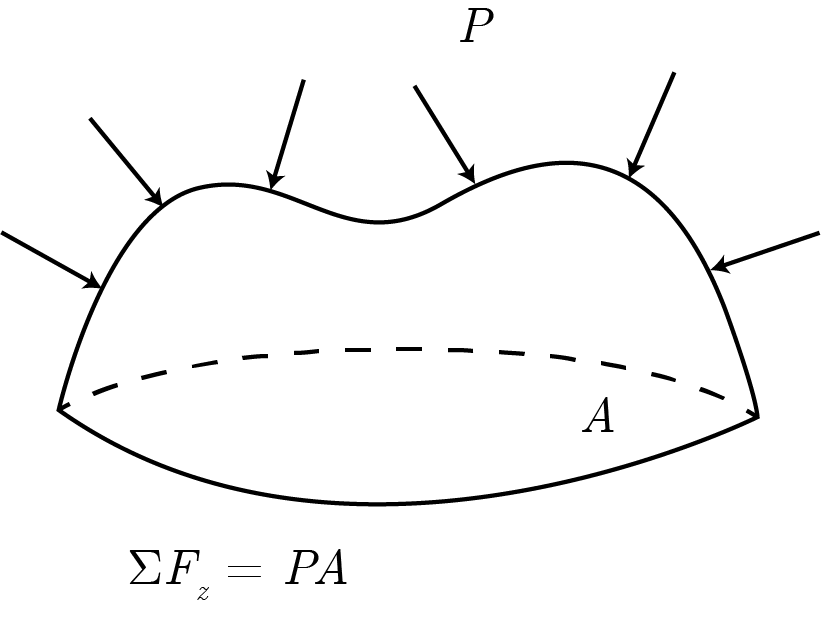
The total force due to a uniform pressure on an arbitrary surface in some arbitrary direction is equal to that pressure multiplied by the area of the projection of that surface onto a plane perpendicular to the direction.
For example, in the figure the combined vertical components $F_z$ of force exerted by pressure all over the surface (call this $S$) simply equals $PA$, where $A$ is the ``projection" or ``shadow" of the surface in the $z$ direction. The proof for this phenomena follows from Newton's laws (see the relevant problem below).
Theorem: Buoyancy force
The buoyancy force on an object in a fluid of density $\rho$ is given by $$F_b=\rho gV_{\text{disp}}$$This force can be imagined to act on the COM of the displaced fluid.
Tip: Accelerating bodies of fluid
When a body of fluid experiences some acceleration, it is often helpful to analyze the situation in an accelerating frame of reference, where the magnitude and direction of the effective gravity may change. All equations involving pressure and buoyancy will then hold in this adjusted frame with the adjusted value of $g$.
Theorem: Mass continuity
In steady state, the mass entering a parcel of fluid must equal the mass leaving the parcel, which implies that $$\rho Av=\text{const}$$
Theorem: Conservation of energy
Also known as Bernoulli's theorem, conservation of energy applied to a moving fluid takes the form $$P+\frac12\rho v^2+\rho gh=\text{const}$$
 For example, in the figure the combined vertical components $F_z$ of force exerted by pressure all over the surface (call this $S$) simply equals $PA$, where $A$ is the ``projection" or ``shadow" of the surface in the $z$ direction. The proof for this phenomena follows from Newton's laws (see the relevant problem below).