Definition: Newton's Law of Gravitation
The gravitational force between two objects $m_1$ and $m_2$ is equal to $$F=\frac{Gm_1m_2}{r^2}$$The gravitational force is always attractive. The gravitational potential energy between two objects, with $U=0$ at infinite distance, is therefore $$U=-\int_r^\infty \frac{Gm_1m_2}{r^2}dr=-\frac{Gm_1m_2}{r}$$
Theorem: Shell theorem
The gravitational acceleration within a hollow, uniformly dense spherical shell is always 0, while the gravitational acceleration outside the shell is as if all the mass of the shell were concentrated at its center.
A natural consequence is that when standing inside a solid planet with spherical symmetry, you only feel the gravitational force due to the portion of the planet underneath you.
Idea: Cosmic speeds
The first cosmic speed $v_1$ is defined as the speed necessary for a planet at a distance $r$ from a star $M$ to move in a circular orbit around the star. The second cosmic speed $v_2$ is defined as the necessary speed for the planet to escape the star, i.e. move an infinite distance away from the star, starting from a distance $r$. It's helpful to memorize these speeds so you don't need to rederive them every time you use them. $$v_1=\sqrt{\frac{GM}{r}}\qquad v_2=\sqrt{\frac{2GM}{r}}$$
Theorem: Conservation laws
The total energy of an orbiting planet $m$ around a star $M$ with semimajor axis length $a$ is conserved, and is equal to $$E=-\frac{GMm}{2a}$$If we choose the star as our origin, there exists no torque acting on the planet, so angular momentum is also conserved, which implies that $$vr_\perp=\text{const}$$
Definition: Kepler's laws
Kepler's laws define the motion of closed orbits. Consider a planet orbiting a star with mass $M$. Kepler's law states that
- The planet's orbit traces a conic section (ellipse, parabola, or hyperbola) with the star at a focus.
- By drawing lines from the planet to the star, the planet sweeps out equal areas in its orbit per unit time. This statement is equivalent to conservation of angular momentum.
- For a planet in a closed elliptical orbit of semimajor axis length $a$, the period of the orbit is $$T=2\pi \sqrt{\frac{a^3}{GM}}$$
Tip: Reduced Mass
One way to deal with two body problems is with reduced mass. The separation between the two bodies, $r(t)$ is the equivalent to the problem with a mass of $$M = m_1+m_2$$ in the center and an orbiting $$\mu = \frac{m_1m_2}{m_1+m_2}.$$
- The energy with reduced mass is given as $$E = \frac{1}{2}\mu v^2 -\frac{GM\mu}{r},$$ and is equal to the total energy of the original setup.
Tip: Effective Mass
Another way is to place an effective mass that causes the same force, $$m_{\text{eff}} = \frac{m_2^3}{(m_1 + m_2)^2},$$ with $m_1$ going around. This is particularly useful for looking at the actual trajectory of one of the masses.
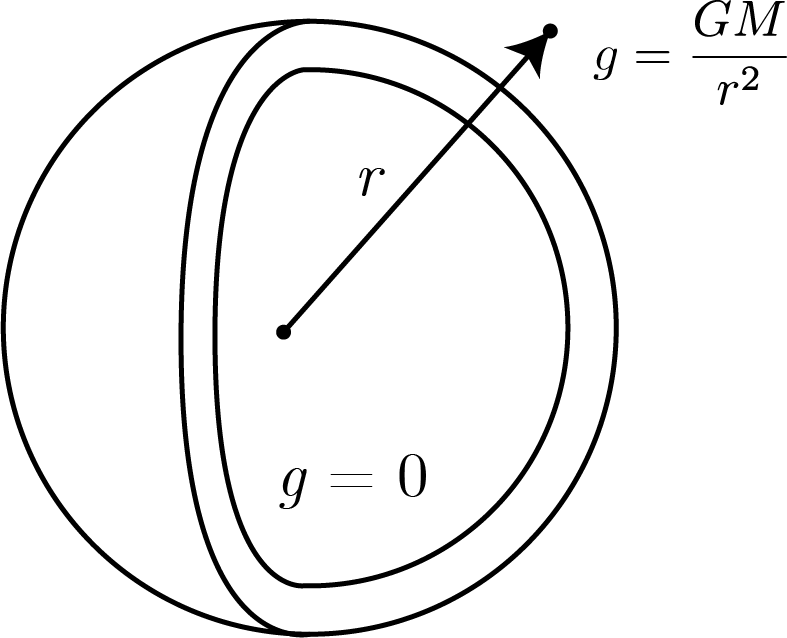 A natural consequence is that when standing inside a solid planet with spherical symmetry, you only feel the gravitational force due to the portion of the planet underneath you.