Definition: Electric Potential
The electric potential $\phi$ is a scalar quantity reflecting the potential energy per unit charge of a point in space. The potential difference (sometimes called voltage) between two points $P_1$ and $P_2$ is related to electric field via $$\Delta \phi=-\int_{P_1}^{P_2}\mathbf E\cdot d\mathbf r$$Consequently the electric field is related to the potential via $$\mathbf E=\left(-\frac{d\phi}{dx},-\frac{d\phi}{dy},-\frac{d\phi}{dz}\right)\equiv -\nabla\phi$$ If we set potential to be 0 at infinity, then the potential at at a given point is well defined: $$\phi=-\int_\infty ^{P}\mathbf E\cdot d\mathbf r$$We can also find the potential at a given point from integrating the scalar contributions from charge in space: $$\phi=\int_V\frac{\rho}{4\pi\epsilon_0 r}dv$$
Given some charge configuration with potential $\phi$ defined at every point in space, moving a charge $q$ from one point to another changes its potential energy via the change in potential: $$\Delta U=q\cdot\Delta \phi$$
Definition: Potential Energy
The potential energy of a charge distribution can be found in two ways. The first, using the electric potential $\phi$ and charge $\rho \, dv$ at all points in space, $$U=\frac 12\int_V\phi \rho \, dv$$The factor $1/2$ comes from the fact that the integral counts each pairwise charge interaction twice, so we divide by 2 to avoid overcounting. The second method is to integrate the potential energy density, which is defined as $$\mathcal U=\frac12\epsilon_0 E^2$$ which is the energy associated with the presence of an electric field $E$ at a given point in space. As a result, the other form of $U$ is $$U=\int_V\mathcal U \, dv=\frac12\epsilon_0\int_V E^2\, dv$$
Definition: Conductors
Conductors are materials in which electrons are free to move. When a conductor is placed into an external electric field, the electrons will move into a configuration at which they stop moving, i.e. when no electric field acts on them anymore. Thus,
a conductor has zero electric field inside it. Some other properties of conductors include
- $\phi$ is a constant value throughout the conductor.
- all charge on a conductor is distributed on its surface.
- the electric field lines right outside a conductor are directed perpendicular to the surface of the conductor and has strength $E=\sigma/\epsilon_0$.
Theorem: Image Charges
Given a charge in the vicinity of a conductor, the charge on the surface conductor will redistribute itself so that the external electric field is directed perpendicularly to the conductor. This redistributed charge will induce a force on the original. There are two special cases of image charges to take note of:
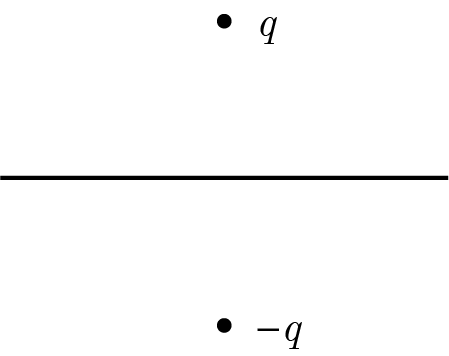
- An infinite conducting plane: For a charge $q$ placed above the plane, the electric field is distributed as if there were an opposite charge $-q$ on the mirror side of the plane.
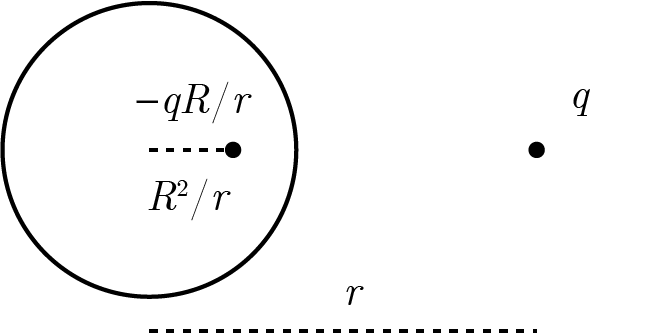
- A spherical conducting shell: For a charge $q$ placed a distance $r$ from the center of the shell of radius $R$, the electric field is distributed as if there were an opposite charge $-qR/r$ a distance $R^2/r$ from the center of the shell.
Note that these cases correspond to when the conductors are grounded, i.e. their potential is 0.
Definition: Dielectrics
For most materials, atoms can rearrange themselves in an electric field to counter the effect of the field. The permittivity of a dielectric is denoted $\epsilon$. The relative permittivity $\kappa$ (sometimes denoted $\epsilon_r$) is given by $\kappa = \epsilon/\epsilon_0.$ The electric field strength is decreased by a factor $\kappa$ within a dielectric; in other words we replace $\epsilon_0$ with $\epsilon$.