Definition: Special Relativity
The posutlates of special relativity are:
- The speed of light is the same in any frame
- There is no preferred reference frame
Theorem: Fundamental Effects
From the postulates, we can derive the three fundamental effects:
- Time dilation: An observer A observes person B's time to be moving slower by a factor of $\gamma$.
- Length contraction: an observer sees lengths contracted by a factor of $\gamma$.
- Loss of simultaneity: simultaneity -- events happening at the same time -- is frame dependent.
where $\gamma = \frac{1}{\sqrt{1-v^2/c^2}}.$
Theorem: Lorentz Transformations
Let the frame $S'$ move with velocity $v\hat{\mathbf x}$ with respect to the frame of the observer, $S$. Then,
$$x = \gamma (x' + vt'), t = \gamma (t'+vx'/c^2), \gamma = \frac{1}{\sqrt{1-v^2/c^2}}.$$
This can also be written in matrix form,
$$\begin{pmatrix}x\\ ct\end{pmatrix} = \begin{pmatrix} \gamma & \gamma \beta \\ \gamma \beta & \gamma \end{pmatrix}\begin{pmatrix}x'\\ ct'\end{pmatrix},$$
where $\beta = v/c$. This can be made even simpler by setting $c = 1$.
Theorem: Invariant Interval
The quantity
$$s^2 = (ct)^2 - x^2,$$
known as the invariant interval, is invariant across Lorentz transformations. You won't see this used much in the olympiad, but the generalization of this -- the magnitude of any
four-vector will be introduced next week and be useful for energy and momentum.
Theorem
If an object moves at velocity $v_2$ in frame $S'$ which moves at velocity $v_1$ with respect to frame $S$, then in frame $S$, the object moves at
$$v = \frac{v_1 +v_2}{1+v_1v_2/c^2}.$$
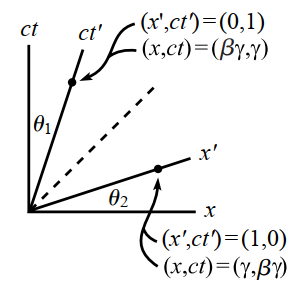
Sometimes, spacetime diagrams, or minkowski diagrams, can be especially helpful for problem solving. They are graphs with a $t$ orc $ct$ vertical axis and $x$ as the horizontal axis, as shown below.
The $45$ degree line represents the path of light. One must be careful though, as the units scale differently:
$$\frac{\text{one }ct'\text{ unit}}{\text{one }ct\text{ unit}} = \frac{\text{one }x'\text{ unit}}{\text{one }x\text{ unit}} = \sqrt{\frac{1+\beta^2}{1-\beta^2}}$$Idea: Rapidity
Rapidity, $\phi$ is defined by
$$\tanh \phi = \beta = v/c.$$
This is especially useful as the Lorentz transform becomes
$$\begin{pmatrix}
x \\ ct
\end{pmatrix} = \begin{pmatrix}\cosh \phi & \sinh \phi \\ \sinh \phi & \cosh \phi\end{pmatrix}\begin{pmatrix}x' \\ ct'\end{pmatrix},$$
analogous to a rotation in 2D. The velocity addition formula also becomes nicer, with
$$\tanh(\phi_1+\phi_2) = \frac{\tanh \phi_1 + \tanh \phi_2}{1+\tanh\phi_1 \tanh \phi_2}.$$