Idea: Mirrors and lenses
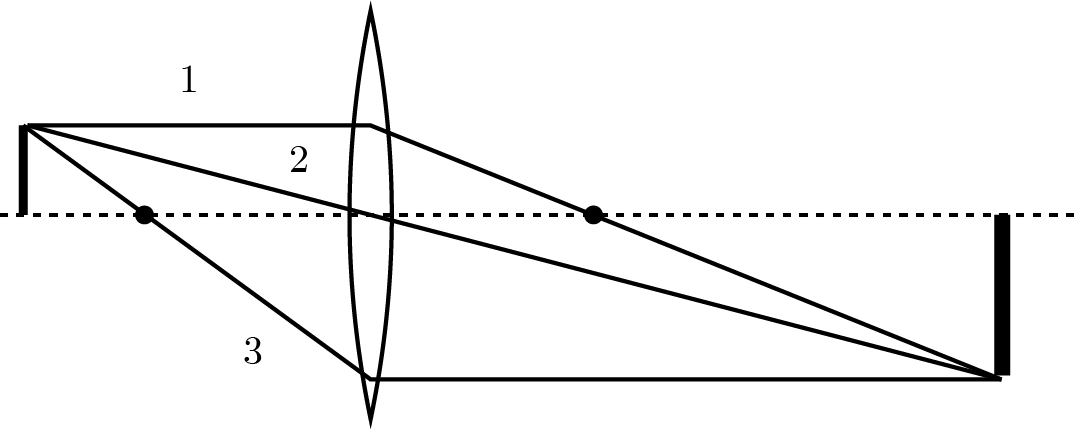
When finding the image of an object from a system with mirrors and lenses, tracing the paths of the following three key rays is helpful:
- A ray drawn parallel to the axis of the lens, which passes through the lens and through the other focus.
- A ray drawn directly through the center of the lens that is not deflected.
- A ray drawn through the nearest focus, which passes through the lens and then moves parallel to the axis.
Definition: Virtual and real images
A real image is created when light rays from the object intersect at one point. A virtual image is created when the light rays do not actually intersect, but their extensions do. For a mirror, a real image is created when the image is on the same side of the mirror as the object, and virtual when not. For a lens, this is the opposite: real images are formed on the other side of the lens, while virtual images are created on the same side as the lens.
Theorem: Lens equation
For lenses (and mirrors), let the focal length be $f$, object distance $o$, and image distance $i$. The object distance is taken to be positive, and the focal distance and image distance are taken to be positive if real and negative if virtual. $$\frac1o+\frac1i=\frac1f$$
The magnification of the image is defined to be the ratio between the final height and the initial height of the object: $$m=\frac {h'}h$$
Definition: Interference
Interference occurs when two points of light of the same wavelength $\lambda$ are emitted from different locations. At places where the phase shift between the sources is 0, we observe constructive interference and at places where the phase shift is $\pi$, we observe destructive interference. For a double slit of separation $d$, the angles at which local maxima occur are found via $$\sin \theta=\frac{N\lambda}{d}$$for $N=0,1,2,\cdots$.
Definition: Diffraction
Within a slit of light of width $a$, we can consider multiple wave fronts. These wave fronts will interfere with one another. The local minima due to diffraction of a slit of light are found via $$\sin \theta=\frac{N\lambda}{a}$$ for $N=1,2,\cdots$.
Tip: Intensity using phasors
When considering the intensity of light due to interference and diffraction, first note that $I\propto E^2$. Then, since $E$ oscillates sinusoidally in an EM wave, consider $E$ to be a phasor rotating in the $xy$ axes with the $x$ component of the phasor representing the magnitude of $E$ at any given point. Then, two waves with phase shift $\phi$ will have phasors $E$ separated by that angle $\phi$, and the total magnitude of the electric can be found via phasor addition.